
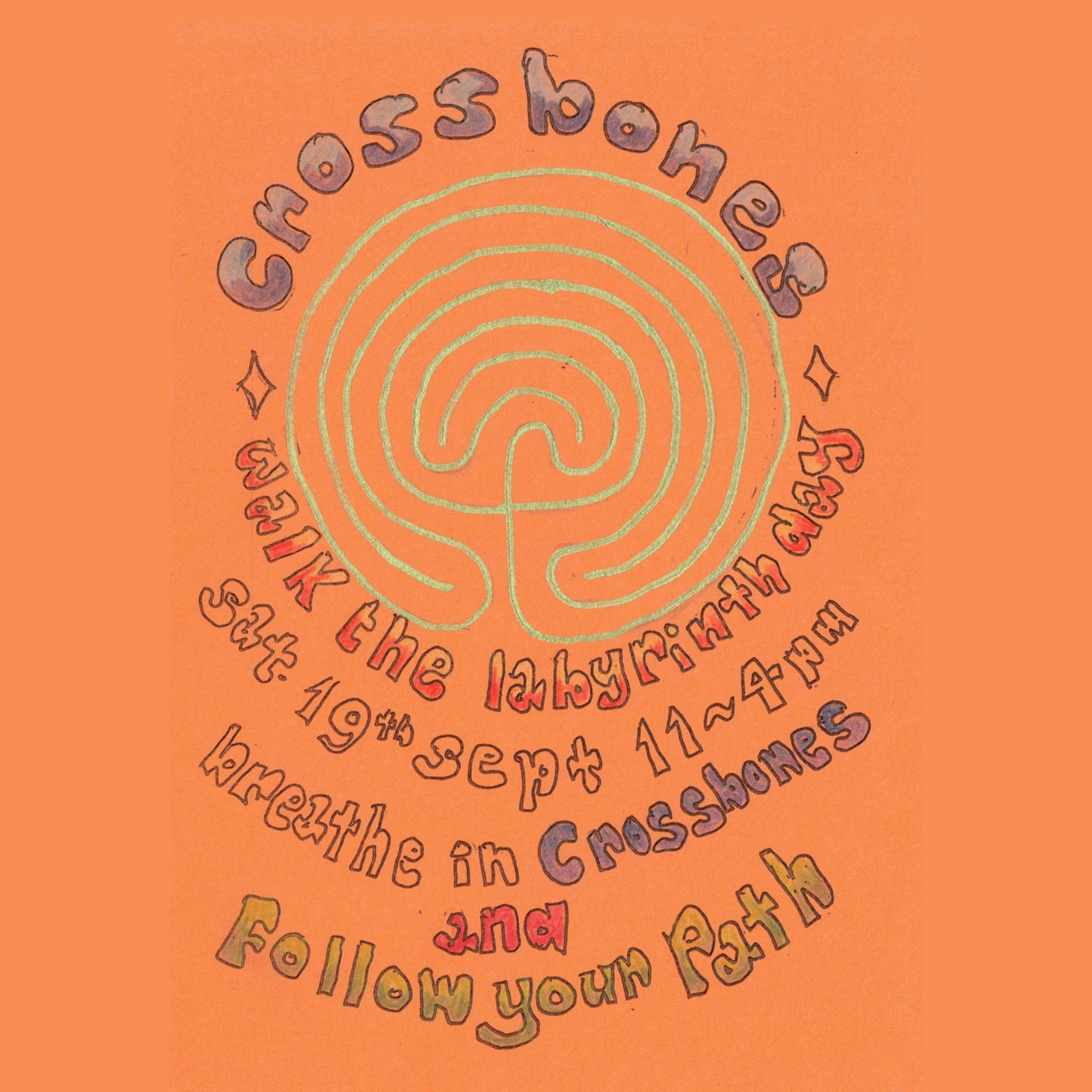
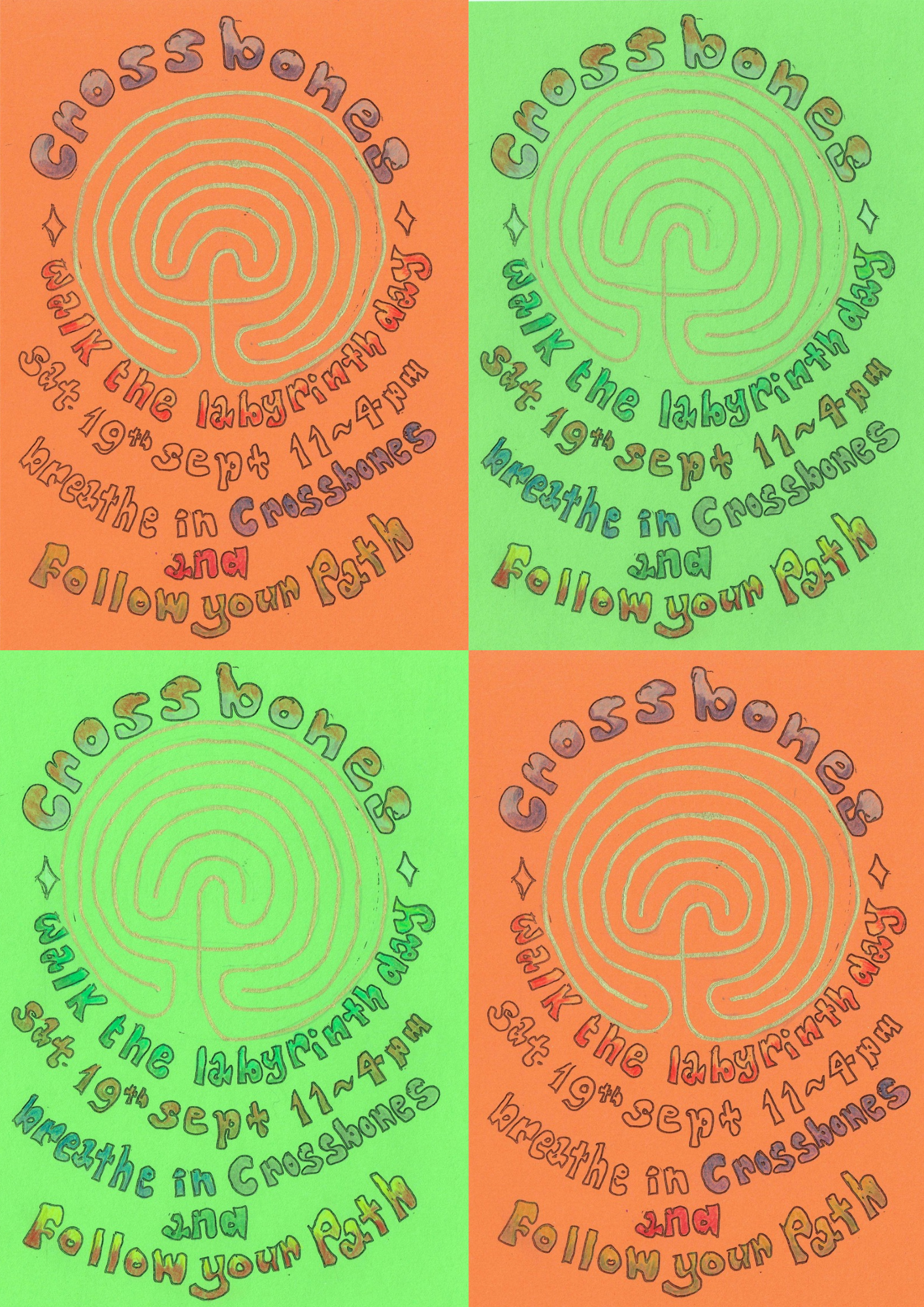
Event Title: Walk the Labyrinth Day at Crossbones Graveyard, presented by Friends of Crossbones
Date & Time: 19th September 2026, 11:00am – 4:00pm
Location: Crossbones Graveyard and Garden of Remembrance, London SE1
Cost: Free (Open to all, drop-in)
About Labyrinth Day at Crossbones
Used for millennia as a teaching tool, the Labyrinth guides the walker in a winding, cursive path from the outer entrance to the centre, to rest there and to return to the outside. It has been used by many different spiritual lineages but its teachings are not confined to a particular practice. Rather, acting as a mirror to each individual walker, it tells us direct things about ourselves and our relationship with what’s outside us.
From the first step on the Labyrinth path, the traveller finds there is no decisions to be made, giving the “leading, logical” part of the brain to take a rest and the “receptive, imaginal” part to flourish in the journey. The Crossbones Walk the Labyrinth Day offers free and open, welcome to all from 11am – 4pm on Saturday 19th September 2026, both to walk the Labyrinth and a place to rest, contemplate and express impressions.
The Labyrinth is laid out on Crossbones holy ground, a peaceful, healing and grounding for each walker. There will be short guided talks for those who wish to partake in a place set by with all sorts of art tools for responses and a teaching corner to learn how to draw your own Labyrinth.
A Universal Symbol of the Human Journey
To step onto a labyrinth is to join a global, multi-millennial tradition. Unlike a maze, which is a puzzle designed to confuse and trap you, a labyrinth has only one continuous path. There are no dead ends, no wrong turns, and no tricks. You simply follow the track to the centre and follow it back out. Because of this beautifully simple geometry, cultures across the globe have independently turned to the labyrinth as a tool for healing, meditation, and self-discovery.
Here is how this ancient pattern has wound its way through human history:
- The Mythic Origins of Greece: The iconic 7-circuit “Classical” pattern is often called the Cretan labyrinth. In Greek mythology, it was crafted by the master architect Daedalus to hold the legendary Minotaur at Knossos, symbolising the untamed, hidden depths of the human psyche. Explore the Greece origins.
- The Sacred Pilgrimage of Medieval Europe: In the Middle Ages, travelling to the Holy Land became too perilous for ordinary people. European cathedrals, most famously Chartres Cathedral in France, laid massive stone labyrinths into their floors. Walking these intricate paths became a symbolic “virtual pilgrimage,” a physical journey of repentance and renewal.
- The “Man in the Maze” of Native America: For the Tohono O’odham Nation of the American Southwest, the labyrinth (known as I’itoi) represents life’s journey. The twists and turns symbolise the choices we make, the experiences that shape us, and the ultimate return to balance and the spiritual world.
- The Protective Stones of Scandinavia: Along the Baltic coasts, ancient stone labyrinths called Trojaborgar (Troy Towns) were built by Norse fishermen. They would walk the winding tracks before heading out to sea, believing the complex paths would confuse and trap malicious wind spirits, ensuring a safe and prosperous voyage. Read A Brief History of Nordic Labyrinths | National Nordic Museum.
The Science of the Stride: How Labyrinths Boost Wellbeing
In our fast-paced urban environments, finding moments of stillness can be incredibly difficult. Modern psychological and neurological research shows that walking a labyrinth acts as a powerful form of somatic mindfulness and active meditation.
Here is how stepping onto the path supports your mental and physical health:
- Silences the “Fight or Flight” Response: The predictable, rhythmic movement of walking a single path without decisions acts as a powerful grounding exercise. Studies indicate this repetitive motion lowers blood pressure, slows heart rates, and reduces cortisol (stress hormone) levels.
- Engages Bilateral Brain Integration: As you navigate the turns of the labyrinth, you naturally alter your direction. Moving back and forth across the central axis requires both the left and right hemispheres of your brain to communicate, which helps process stuck emotions and brings a sense of mental clarity.
- Encourages Deep “Open Monitoring” Meditation: Because the route requires no problem-solving or logical tracking, your brain transitions out of stressful “analytical” beta waves and into relaxing alpha and theta waves. This transition is highly effective for reducing anxiety and easing symptoms of burnout.
- Provides a Safe Container for Grief and Reflection: The physical boundaries of the labyrinth offer a secure, symbolic space to experience complex feelings. For sites like Crossbones Graveyard, walking the path provides a meaningful way to process grief, honour ancestors, and find a sense of closure or peace.
Dig Deeper: Research & Resources
If you are inspired to explore the history, geometry, or psychology of labyrinths before the Crossbones event, check out these exceptional resources:
- The Labyrinth Society: The premier global hub for history, research, and community events centred around unicursal paths.
- The World-Wide Labyrinth Locator: A massive, searchable global database that helps you find public and private labyrinths in your area.
- Veriditas: An organisation dedicated to introducing the labyrinth as a personal practice for modern mindfulness, stress relief, and spiritual transformation.
We look forward to seeing you on Saturday 19th September. Follow us on instagram: BOST or Crossbones Graveyard for updates about Crossbones and BOST.